My Projects
1. Multi-User Order Management System (Backend Development Project)
Tools: Java, MySQL, JDBC, JSP, Maven
Type: Backend System Development · Database Applications
🧭 Overview
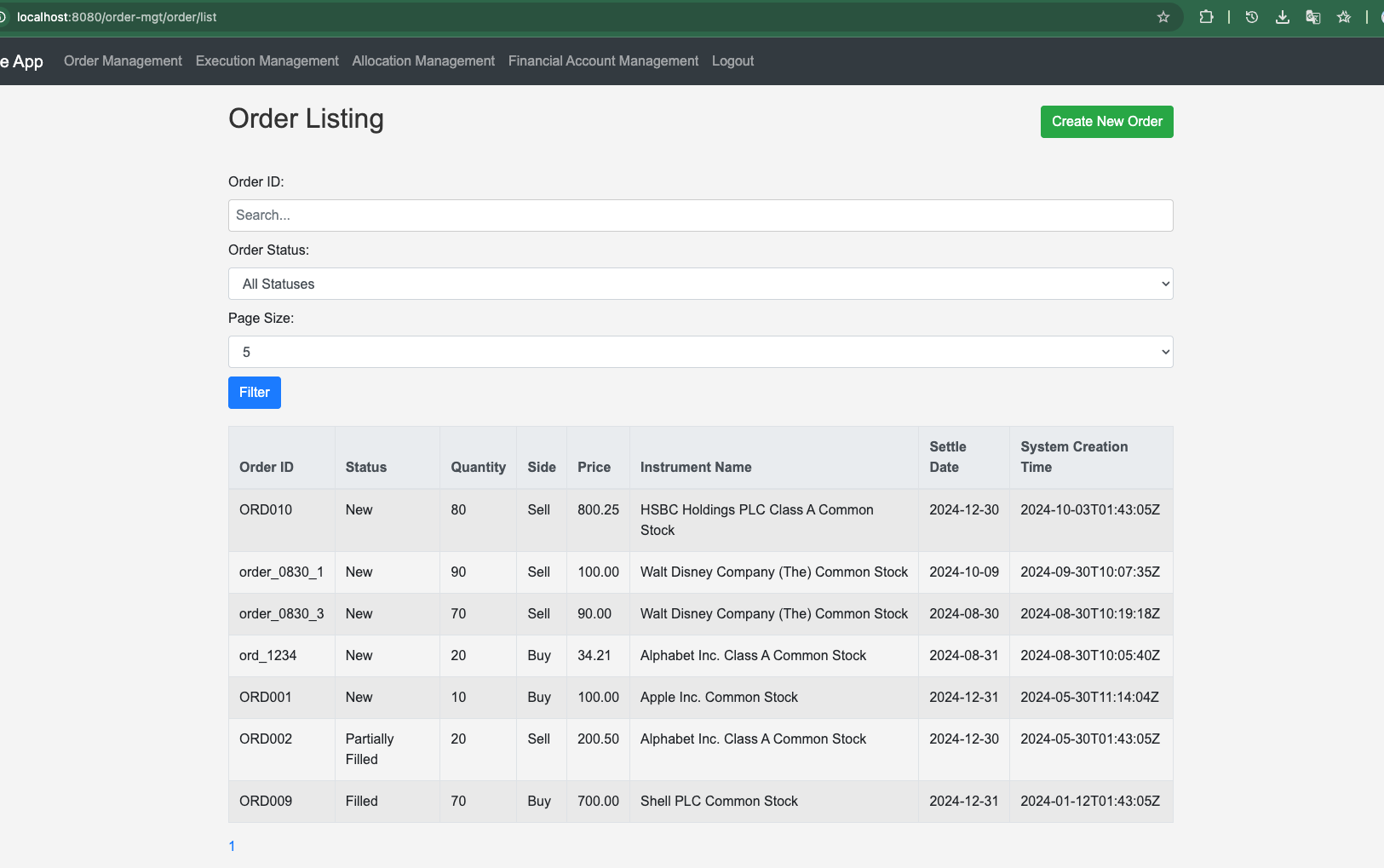
This project focuses on building a multi-user order management system that simulates key components of backend systems commonly used in trading or transaction platforms.
The system allows users to create, manage, and track orders, while maintaining persistent storage in a relational database. The project explores how backend application logic, database schema design, and user interfaces interact within a full-stack data-driven system.
Two versions of the system were developed:
JDBC-based backend implementation focusing on database interaction and system architecture
🔗 GitHub Repository - Order-Management-JDBC-MydemoJSP-based web application providing a browser interface for order operations
🔗 GitHub Repository - Order-Management-JSP-Mydemo
The project continues to evolve as additional features and system improvements are implemented.
🔧 What I Implemented
- Designed a relational database schema supporting orders, users, and role-based access
- Implemented Java backend services using JDBC to interact with a MySQL database
- Built DAO-based architecture to separate database access logic from application logic
- Implemented CRUD operations for order creation, updates, queries, and deletion
- Developed a JSP-based web interface allowing users to submit and manage orders through a browser
- Structured the project using Maven multi-module organization for maintainable backend development
⚙️ System Capabilities
- Multi-user order submission and management
- Database-driven order lifecycle tracking
- Persistent storage of transaction records in MySQL
- Web-based order management interface (JSP version)
- Modular backend structure for future feature expansion
🚧 Current Development
The system is actively under development. Planned improvements include:
- Enhanced order validation and error handling
- Expanded order status workflows
- Improved database performance and query optimization
- Additional frontend features for more complex transaction scenarios
2. UIUC Student Data Analysis & Tableau Dashboard - ATLAS Internship in UIUC
Tools: Python, Tableau
Type: Data Analytics Internship
🧭 Overview
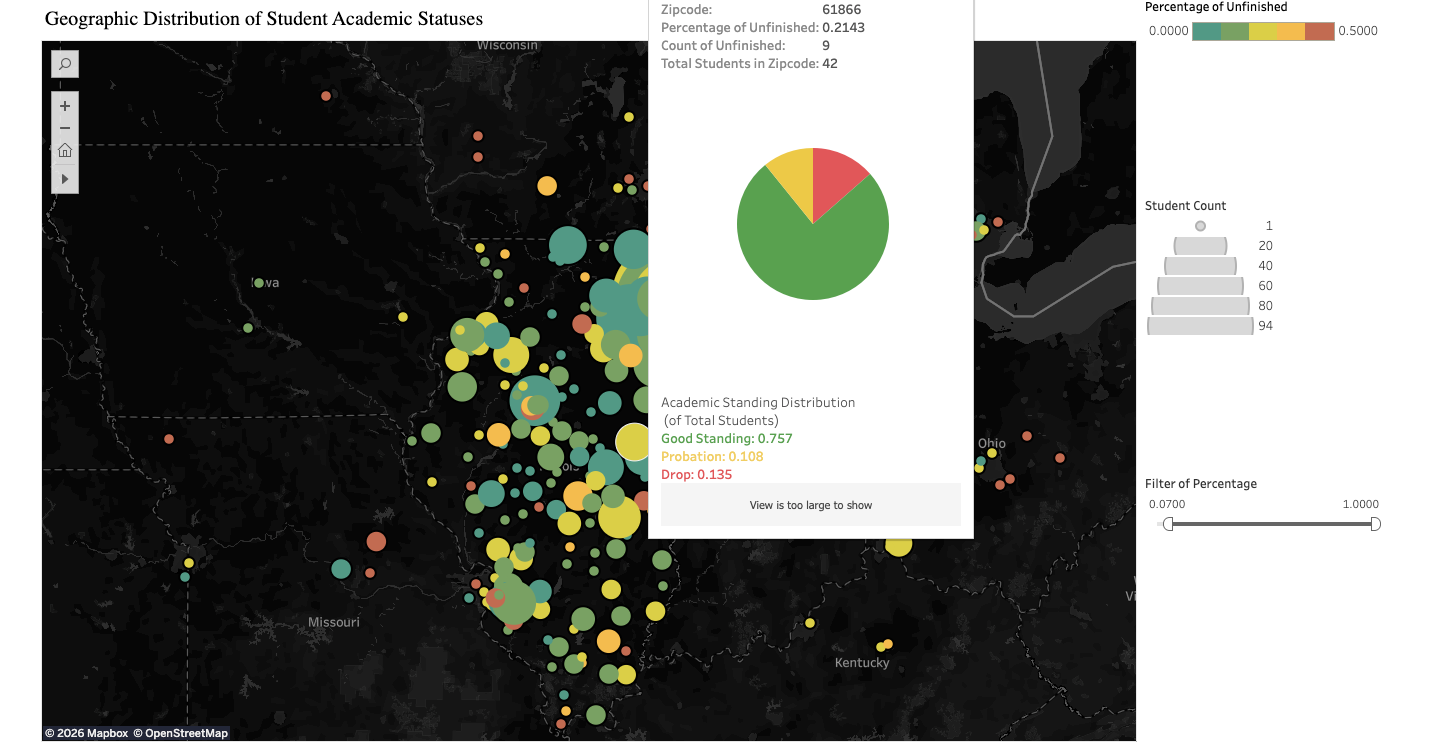
This project focuses on analyzing UIUC student datasets to uncover patterns related to academic performance and student outcomes. The goal was not only to analyze the data and find students at risk of dropping out, but to translate complex academic information into clear, interactive visual insights that can be understood by both technical and non-technical audiences.
🔍 What I Did
- Cleaned and validated institutional student data, ensuring consistency across academic records
- Researched and analyzed key academic indicators such as GPA, academic standing, social economic status, and geographic attributes that may influence student success
- Explored patterns in unfinished students and academic risk levels through exploratory analysis
- Built interactive Tableau dashboards to allow users to explore trends and compare student outcomes dynamically
- Built exploratory machine learning models (e.g., Random Forest) to examine predictors of academic risk and evaluate how well student features could signal potential academic probation or dropout risk
📊 Key Insights
- Student academic outcomes exhibit clear geographic disparities across regions
- Students from areas with less access to educational resources show a higher proportion of unfinished enrollment
- These regions also contain a larger share of students in poor academic standing, including probation-level status
- The coexistence of unfinished enrollment and academic risk suggests that structural and regional factors may play an important role in student performance
🎯 Why This Project Matters
Rather than presenting static charts, this project emphasizes data storytelling and clarity.
By allowing users to interact with the dashboard, researchers and educators can: - Explore academic patterns independently across different student groups
- Identify students who may be at potential academic risk and require additional attention
- Better understand how multiple factors relate to student progress and outcomes
🔗 Output
- 👉 Interactive Tableau Dashboard:
View on Tableau Public
3. Web Development – Community Service Center of Northern Champaign County
Tools: WordPress, HTML, CSS
Type: Web Development Internship
🧭 Overview
Redesigned and improved a community service organization’s website to make key resources easier to find and to support a broader audience with bilingual content. The focus was on real-world usability: helping visitors quickly locate services, learn how to volunteer, and complete donations with fewer steps.
🔧 What I Delivered
- Rebuilt the site structure and navigation, reorganizing content so visitors can easily locate key information such as services, events, and volunteering opportunities
- Redesigned and updated core pages, including Service and Volunteer sections, to improve clarity and usability
- Implemented a bilingual language experience (English / Spanish) and maintained content consistency across both versions
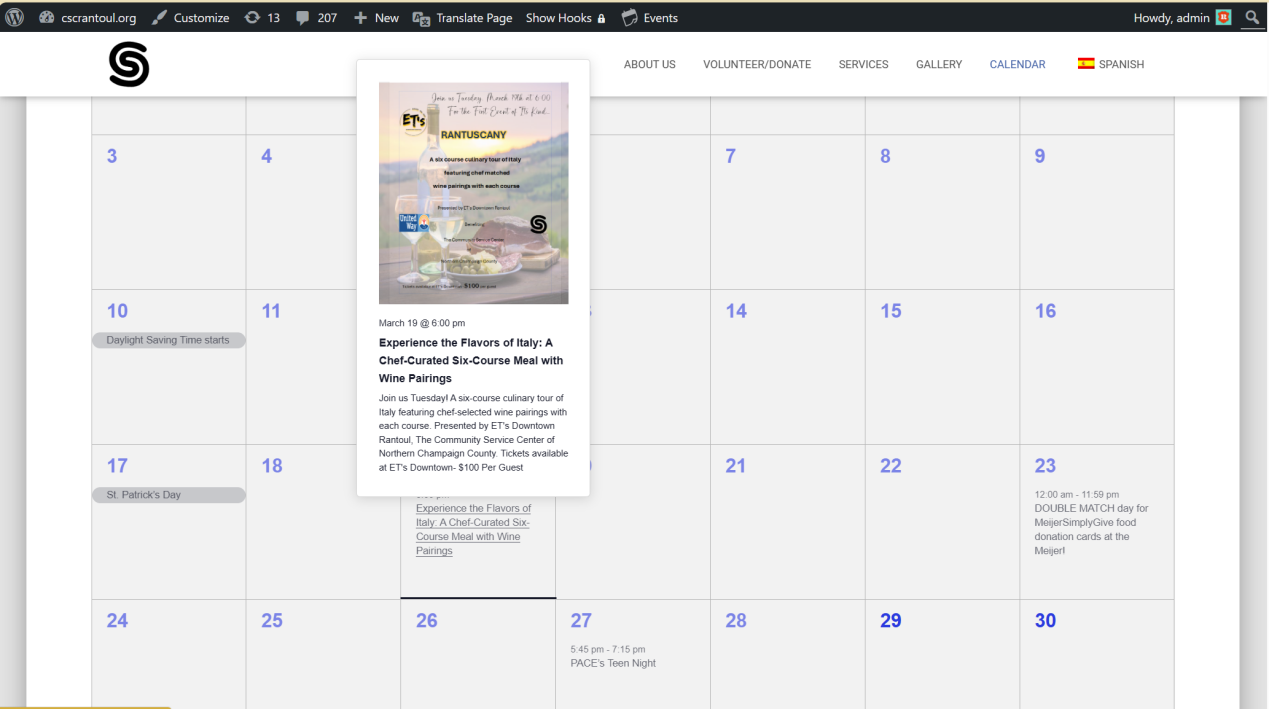
- Created and maintained an interactive event calendar, enabling staff to freely add, edit, and remove events
- Designed event pop-up interactions that display event details on hover, improving event discoverability
- Regularly updated event content and media, including adding new activities, descriptions, and photos to keep the site current
✅ Impact
- Improved information accessibility for diverse community members, including bilingual audiences
- Increased visibility of community events and activities through a clear, regularly updated event calendar
- Delivered a more consistent and maintainable website structure to support ongoing content updates
🔗 Output
- Archived version of the live production website:
View via Internet Archive
Note: The website has since been updated and maintained by other contributors after my internship.
This archived version reflects the site structure and content during my contribution period.
Some dynamic elements (e.g., event calendar interactions or gallery images) may not fully load due to archiving limitations.
Event page (captured during normal operation):
4. QuickPlate – Food Recipe Mobile App (HCI Design Project)
Tools: Figma
Type: UX / UI Design · Human-Computer Interaction
🧭 Overview
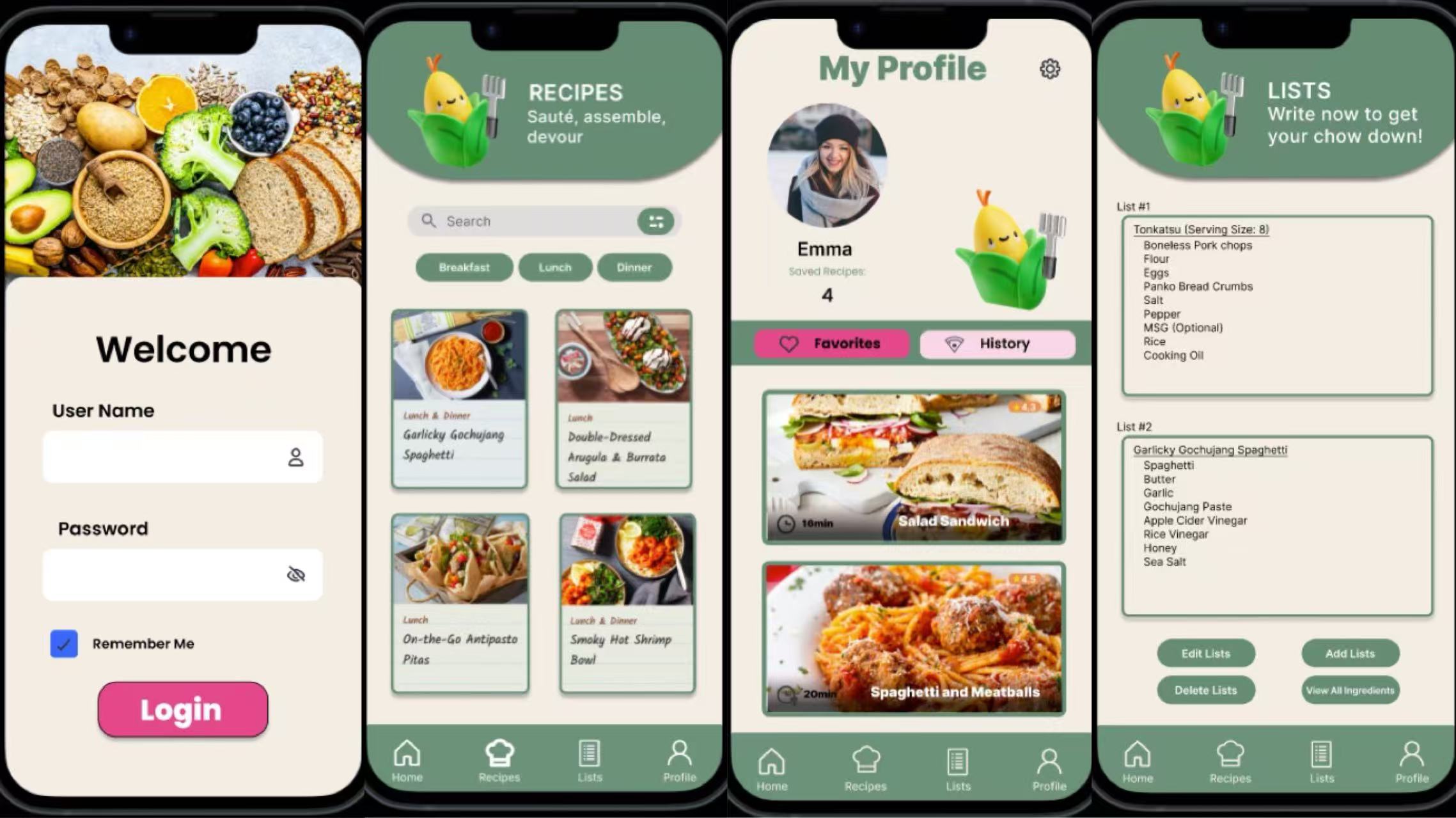
QuickPlate is a mobile recipe application designed to help users quickly find meals that match their time constraints, budget, dietary preferences, and available ingredients.
The project focuses on reducing the cognitive and emotional burden of meal planning, especially for busy students and individuals with limited time.
👤 User Problem & Use Cases
This app was designed around realistic, everyday scenarios, such as: - A student returning home after work who wants to cook using only the ingredients already available - Users with limited time who need recipes filtered by total cooking time - Individuals looking to explore new dishes without complicated preparation steps
QuickPlate addresses these needs by allowing users to filter recipes by ingredients, cooking time, cost, time of day, and dietary preferences (e.g., vegetarian or vegan).
🧩 Design Process
- Conducted analysis of existing recipe apps to identify gaps in usability and feature focus
- Prioritized simplicity and quick decision-making over excessive recipe complexity
- Designed user flows that support:
- Saving and editing personal recipes
- Generating a combined ingredient list that functions as a shopping list
- Tracking cooked meals and favorited recipes through a user profile
- Saving and editing personal recipes
♿ Accessibility & Inclusive Design
Accessibility was a core consideration throughout the design:
- Mobility impairments: Large buttons, simplified interactions, and layouts optimized for one-handed use
- Cognitive accessibility: Consistent layouts, clear iconography, and reduced visual clutter to lower cognitive load
- Neurodiversity & mental health: Calm color palette, no flashing elements, and predictable navigation to reduce stress and anxiety
These choices were made to ensure the app is usable, welcoming, and easy to learn for a wide range of users.
🎯 Outcome
The final Figma prototype demonstrates: - A complete end-to-end user flow from recipe discovery to meal tracking
- Clear information hierarchy and intuitive navigation
- A design that balances functionality, accessibility, and visual clarity
🔗 Output
- 👉 Interactive Figma Prototype:
View Prototype
- 🎥 Design Walkthrough Video
The following video presents a walkthrough of the QuickPlate prototype, including design motivation, challenges encountered, key decisions, and scenario-based demonstrations of how users interact with the app. 😆
5. 3D Cardiac Electrophysiology Simulation (Research Project)
Tools: C, CUDA, Python, VTK, ZeroMQ
Type: GPU-Accelerated Simulation · Research Project
🧭 Overview
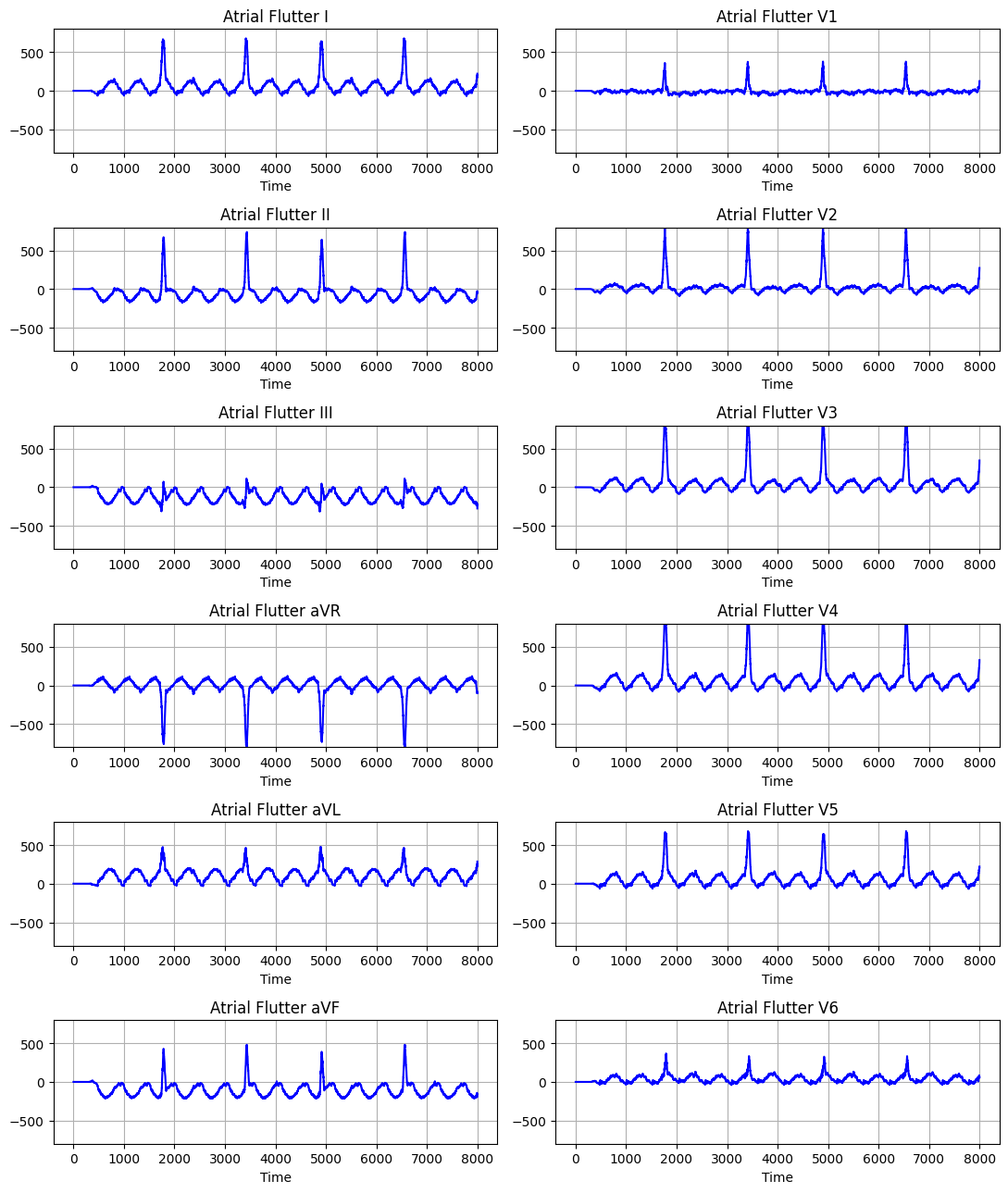
This research project focuses on building a high-performance 3D cardiac electrophysiology simulation system using GPU acceleration to model how electrical signals propagate through the heart and generate realistic ECG signals. The goal is to simulate both normal and abnormal cardiac electrical activities, enabling forward modeling of heart behavior to support research in arrhythmia mechanisms and future clinical decision tools.
🔬 What I Did
- Implemented and optimized cellular automata–based cardiac cell state transitions, modeling depolarization, refractory periods, and repolarization processes
- Developed CUDA-based parallel computation pipelines to update millions of cardiac nodes efficiently across the 3D heart model
- Improved the simulation logic to include missing electrophysiological stages, making signal propagation more physiologically realistic
- Built flexible pacemaker and abnormal activation mechanisms via ZeroMQ interfaces to simulate pathological excitation sources
- Adjusted model parameters to reproduce clinically realistic ECG signals and cardiac rhythms
⚡ Electrophysiological State Modeling
Each cardiac cell transitions through physiological states: REST → ERP → RRP → REST
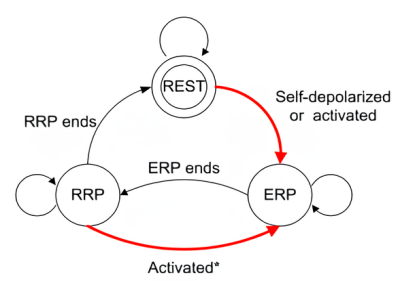
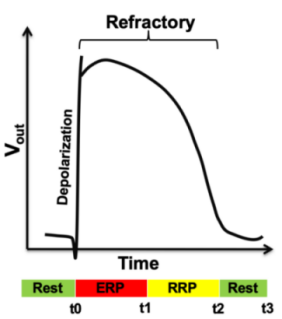
These transitions simulate depolarization, refractory periods, and recovery, enabling realistic propagation of electrical waves.
📈 ECG Generation from Simulation
Electrical signals produced by cardiac cells are aggregated into a global heart vector and projected onto different lead directions, allowing simulation of realistic 12-lead ECG signals.
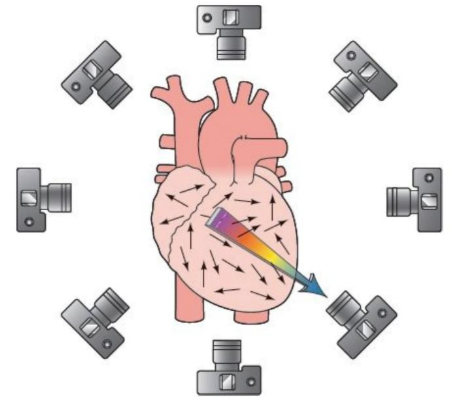
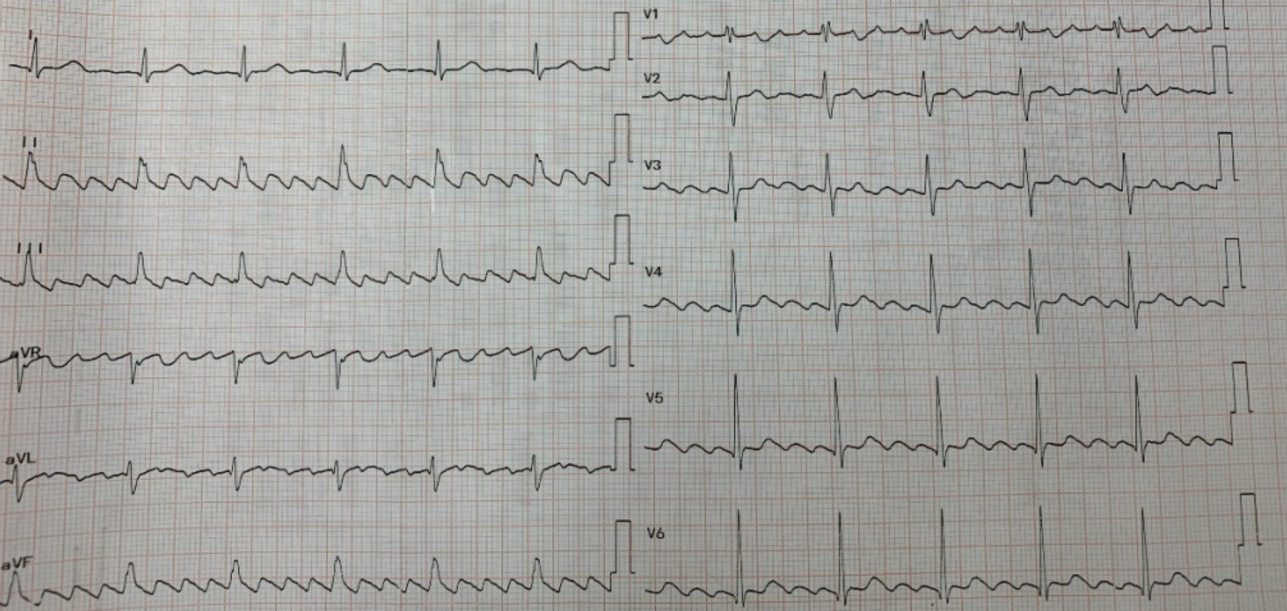
Source: Garcia TB. Introduction to 12-lead ECG: The Art of Interpretation, 2nd ed., 2015.
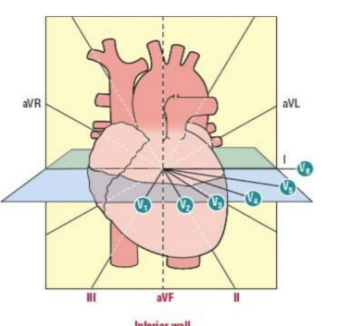
Source: Garcia TB. Introduction to 12-lead ECG: The Art of Interpretation, 2nd ed., 2015.
😎Key Results
- Successfully simulated electrical propagation across atria, ventricles, and conduction pathways in a full 3D heart structure
- Generated realistic 12-lead ECG signals, including recognizable P waves and QRS complexes
- Reproduced abnormal rhythms such as:
- Premature Ventricular Contractions (PVCs)
- Atrial Flutter
- Achieved significant performance gains using GPU acceleration, enabling large-scale simulations previously infeasible on CPUs
🎯 Why This Project Matters
- Traditional diagnosis infers internal cardiac problems from surface ECG signals. This project instead enables forward simulation, allowing researchers to observe how internal electrical abnormalities generate observable ECG changes.
- Such simulations support:
- Arrhythmia mechanism research
- Digital twin heart modeling
- Pre-operative planning and diagnostic assistance
- Future intelligent clinical decision systems